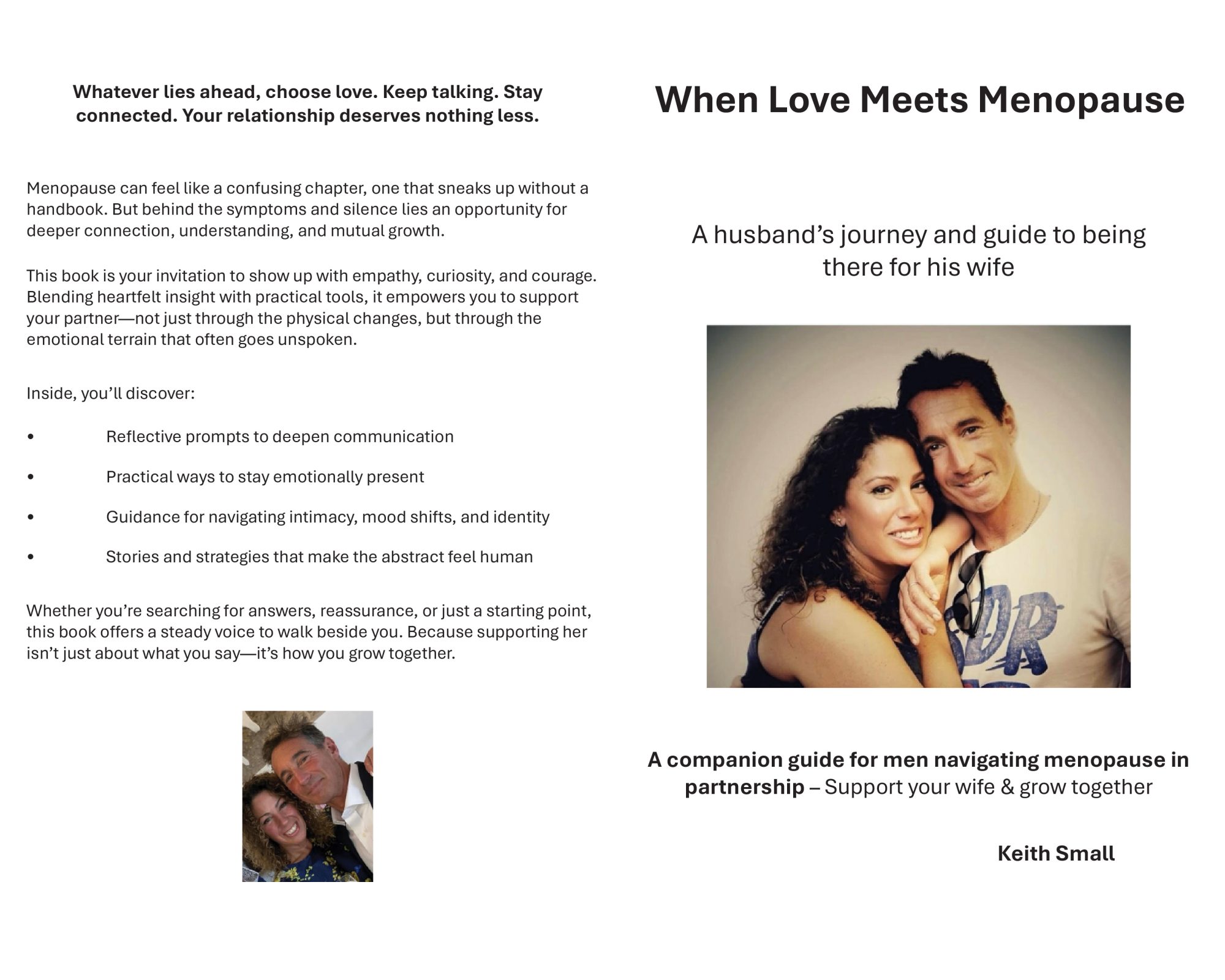
For over twenty years, my wife and I shared a bond built on laughter, honesty, and mutual respect. We rarely argued, and we genuinely enjoyed each other’s company. Our relationship was rooted in peace. And then, seemingly out of nowhere, things shifted.
Suddenly, it felt like I couldn’t do anything right. Even something as small as me breathing in her direction could spark tension. I found myself constantly asking, “What did I do?” The problem was, I didn’t know: and worse, I couldn’t fix it.
That feeling of powerlessness is what led me to write my new book, When Love Meets Menopause. I wanted to share my journey: not as a doctor or a medical expert, but as a husband who was doing his best while feeling completely upside down. Today, I’m thrilled to officially announce the launch of this book and share how it can serve as a vital piece of your own personal “menopause toolkit.”
The “Fixer” Trap
As men, I think many of us are wired to solve problems. When we see our partner in distress, our instinct is to jump in, restore the calm, and fix the situation. But menopause isn’t a broken faucet or a flat tire. It’s a complex, deeply personal transition that can’t be “solved” with a quick tip or a logical argument.
In those moments of tension, my “fixer” instinct actually deepened the divide between us. I didn’t understand what was happening, and my wife didn’t always have the words to explain it. I searched through our routines, our finances, and our interactions, trying to find the “error” in the system. But the answer wasn’t in the external details; it was in the internal shift she was experiencing.
Learning to move from being a “fixer” to a “listener” was one of the hardest lessons I’ve had to learn. It required me to step back, park my ego, and simply be present. I realized that my wife didn’t need me to have all the answers; she needed me to have the patience to stay in the room when things got uncomfortable.
Why This Matters Beyond the Home
You might wonder why a business that focuses on workplace motivation strategies and professional development coaching is talking about menopause. The truth is, our personal lives and our professional lives aren’t separate compartments. If things are shaky at home, it’s incredibly difficult to show up as your best self at work.
When a partner is navigating menopause, the emotional, physical, and relational ripple effects are significant. It affects sleep, focus, and overall mental resilience. By educating yourself and becoming a more supportive partner, you’re not just saving your relationship: you’re building the emotional intelligence and resilience that makes you a better leader and colleague. Understanding these human drivers is at the very core of how well you know yourself and others.
A Roadmap Through the Chaos
I didn’t write this book to be a medical manual. You won’t find deep dives into hormone therapy or clinical jargon. Instead, you’ll find a collection of reflections, hard-won lessons, and hopeful moments from one man learning how to show up with grace.
Here is a glimpse of the journey we take in the book:
- Chapter 1: Educating Yourself: Moving beyond the “what” to the “why” of symptoms like brain fog and mood swings.
- Chapter 2: Communication is Key: Learning how to talk when the old ways of communicating aren’t working anymore.
- Chapter 3: Practicing Patience: How to build the emotional strength to be the steady presence your partner needs.
- Chapter 5: Strengthening Intimacy: Rediscovering connection when the rhythm of your relationship has changed.
- Chapter 7: Understanding Your Own Needs: Because you can’t pour from an empty cup; your emotional wellbeing matters too.
Building Your Own Resilience
Supporting a partner through this phase is a marathon, not a sprint. It demands a high level of mental resilience. I’ve often found that the same principles I teach in my short courses on mindset apply directly to this journey. It’s about choosing your attitude each day, even when you feel exhausted or confused.
In the book, I share a tool called “The Understanding Loop.” It’s a simple framework: You share your feelings, she shares hers, and together you reflect on how to make it easier next time. It’s not about avoiding conflict; it’s about having a commitment to repair and grow together. Relationships thrive when there is a shared commitment to staying in the dance, even when the music changes.
A Shared Journey Forward
Menopause signaled an ending for us: an ending to the way things used to be. But it also signaled a beginning. When we both realized that things had to change, we unlocked a deeper form of love grounded in respect and renewal.
I wrote When Love Meets Menopause because I want you to know that if your world feels upside down right now, you aren’t alone. There are tools and choices that can help you grow through this together. It’s about learning to “see” your partner again: not as who she was, but as who she is becoming.
Join Me for the Next Step
The book is just the start of the conversation. I’m also excited to announce a 3-week online course designed specifically for couples and partners to navigate this transition together. We’ll dive deeper into the strategies mentioned in the book, providing a safe space to move from overwhelm and chaos to true connection.
If you’re ready to start this chapter with more clarity and less frustration, I’d love to have you join me. My book, When Love Meets Menopause, is available now (here’s the link – When love meets menopause: A companion guide for men navigating menopause in partnership with their wife: Amazon.co.uk: Small, Mr Keith: 9798197666673: Books), and I’ll be sharing more details about the upcoming course very soon.
If you have questions or just want to chat about how coaching can help you navigate these personal or professional transitions, feel free to reach out. I’m here to help you find your path to success, whatever that looks like for you right now.