Have you ever looked at a high-performing team and wondered exactly what makes them tick? Or perhaps more importantly, have you ever looked at a talented group of people who just aren’t clicking and struggled to figure out why?
In my years of team performance coaching, I’ve found that most leaders are flying blind. They use traditional employee engagement tools that measure satisfaction: things like “how do you feel about the office coffee?” or “is your chair comfortable?”: but they completely miss the mark on motivation.
Satisfaction is about the past; it’s about how things have been. Motivation is about the future. It’s the fuel in the tank. If you don’t know what fuels your people, you can’t expect them to go the distance. That’s where Motivational Mapping changes everything. It’s not just another personality test; it’s a diagnostic tool that reveals the invisible drivers of human performance.
What is Motivational Mapping?
Motivational Mapping is an ISO-accredited, online diagnostic tool originally created by James Sale. Unlike personality tests like Myers-Briggs or DISC, which tell you who someone is, a Motivational Map tells you what they want. It focuses on energy and emotions rather than static traits.
When I work with organisations, I use these maps to provide a clear, data-driven language for something that is usually quite “fluffy.” It identifies nine core motivators and ranks them for each individual. More importantly, it measures how well those motivators are being met in their current role.
Think of it as a dashboard for your team’s energy. If a team member’s top driver is “Searcher” (the need for meaning) but they spend all day doing repetitive data entry with no feedback on why it matters, their tank is going to run dry. No amount of “Employee of the Month” vouchers will fix that.
The Nine Core Drivers: The Matrix of Motivation
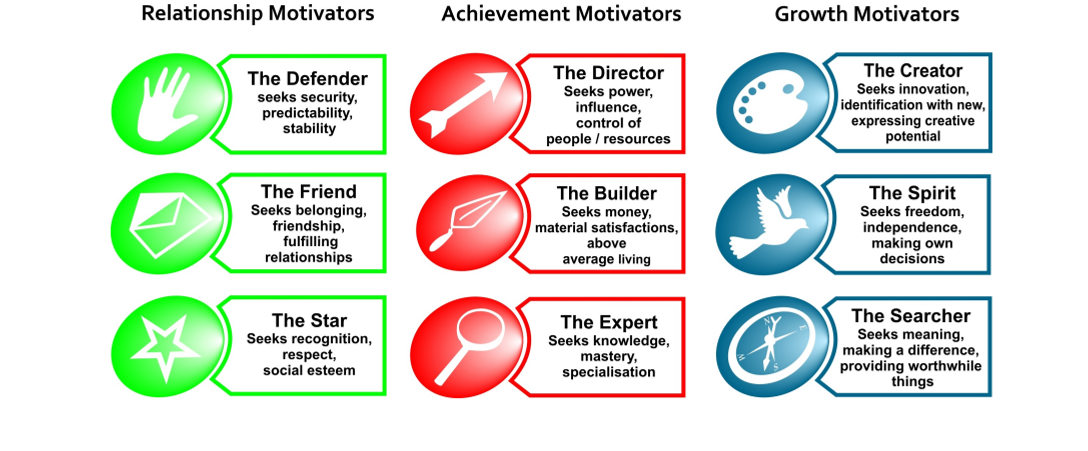
To understand your team, you first have to understand the nine core motivators. I categorize these into three distinct clusters: Relationship, Achievement, and Growth. Every person has all nine, but the order and intensity are unique to them.
1. The Relationship Cluster (Focus on the Past/Security)
These drivers are about how we relate to others and the environment around us.
- The Defender: They seek security, stability, and predictability. They love clear roles and frequent communication.
- The Friend: They are driven by belonging and fulfilling relationships. For them, the team culture is more important than the task.
- The Star: They need recognition, respect, and social esteem. They want to be seen and valued for their contribution.
2. The Achievement Cluster (Focus on the Present/Action)
These drivers are about getting things done and making a tangible impact.
- The Director: They are motivated by power, influence, and the ability to manage people or resources. They want responsibility.
- The Builder: They seek material gain, a high standard of living, and competitive rewards. They are the “commercial” engines of a team.
- The Expert: They are driven by knowledge, mastery, and specialisation. They want to be the best at what they do.
3. The Growth Cluster (Focus on the Future/Potential)
These drivers are about personal evolution and internal meaning.
- The Creator: They thrive on innovation, change, and problem-solving. If things stay the same for too long, they get bored.
- The Spirit: They need freedom, autonomy, and the ability to make their own decisions. They hate being micromanaged.
- The Searcher: They seek purpose and want to know that their work is making a real difference in the world.
Why This is a Game-Changer for Workplace Culture
Most workplace motivation strategies fail because they assume everyone wants the same thing. We’ve been taught to “treat others how you want to be treated,” but in leadership, that’s a mistake. You should treat others how they want to be treated.
When I implement Motivational Mapping in an organisation, the first thing I notice is the shift in communication. Instead of a manager guessing why an employee is disengaged, they have a map that says, “This person is a high ‘Spirit’ but they feel trapped in a rigid schedule.”
Suddenly, the solution isn’t a pay rise (which might not matter to them if they aren’t a ‘Builder’); the solution is giving them more autonomy over their Thursday afternoons. This level of precision is what transforms a toxic or stagnant culture into one of trust and high performance.
Transforming Team Performance Through Data
I often see teams that look great on paper: highly skilled, experienced, and well-paid: yet they are underperforming. Usually, it’s because of a “motivational clash.”
Imagine a team where the leader is a high “Director” (wants control) and the most senior specialist is a high “Spirit” (wants freedom). Without the language of Motivational Mapping, this looks like a personality clash. The leader thinks the specialist is a “renegade,” and the specialist thinks the leader is a “control freak.”
Once we map them, I can show them the data. We realize it’s not personal; it’s just a difference in drivers. We can then set 30-day goals to bridge that gap. We might agree that the leader provides the “what” (the goal) but lets the specialist decide the “how” (the process).
This is how employee engagement tools should work: they should provide actionable, real-world behavioral changes that stick.
Real-World Examples: Motivation in Action
Let me share a story from a recent session. I worked with a commercial manager who was frustrated with his top salesperson. The salesperson was hitting targets but seemed miserable and was looking for other jobs. The manager assumed it was about money and offered a bonus, but it didn’t help.
We did the Mapping. It turned out the salesperson’s top motivator was “Searcher” (meaning) and their “Builder” (money) score was actually quite low. They were hitting targets because they were good at their job, but they felt like they were just moving numbers on a spreadsheet.
I advised the manager to involve the salesperson in a new corporate social responsibility project and to start sharing client testimonials that showed the real-world impact of the products they sold. Their motivation score shot up by 40% within a month. No extra money spent: just a shift in alignment.
The Path to Your Full Potential
Motivation isn’t a “one and done” thing. It’s dynamic. Your drivers change as your life changes. What motivated you at 25 probably doesn’t motivate you at 45. This is why I believe in regular “check-ins” and mapping as part of a long-term coaching journey.
If you’re a manager, understanding your own map is just as important as understanding your team’s. If you’re a high “Expert” but your role is now 100% people management, you might be feeling drained because you aren’t getting your “knowledge fix” anymore. Recognizing that allows you to find ways to integrate mastery back into your week.
Let’s Find Your Map
Building a resilient, high-performing team doesn’t happen by accident. It happens by design. If you’re tired of the “engagement” guesswork and want to see the real data behind your team’s performance, I’d love to help you navigate that.
I offer short courses on building mental resilience and positive mindsets, but for organisations looking for deep-rooted change, a Motivational Mapping workshop is the most powerful place to start. It gives you the “why” so you can finally master the “how.”
If you’re curious about how this could work for your specific team or if you want to understand your own drivers better, let’s have a chat. I’m always happy to jump on a call and explore how we can get you and your team “getting on with it.”
Book a 30-minute taster session here to see the power of mapping for yourself.