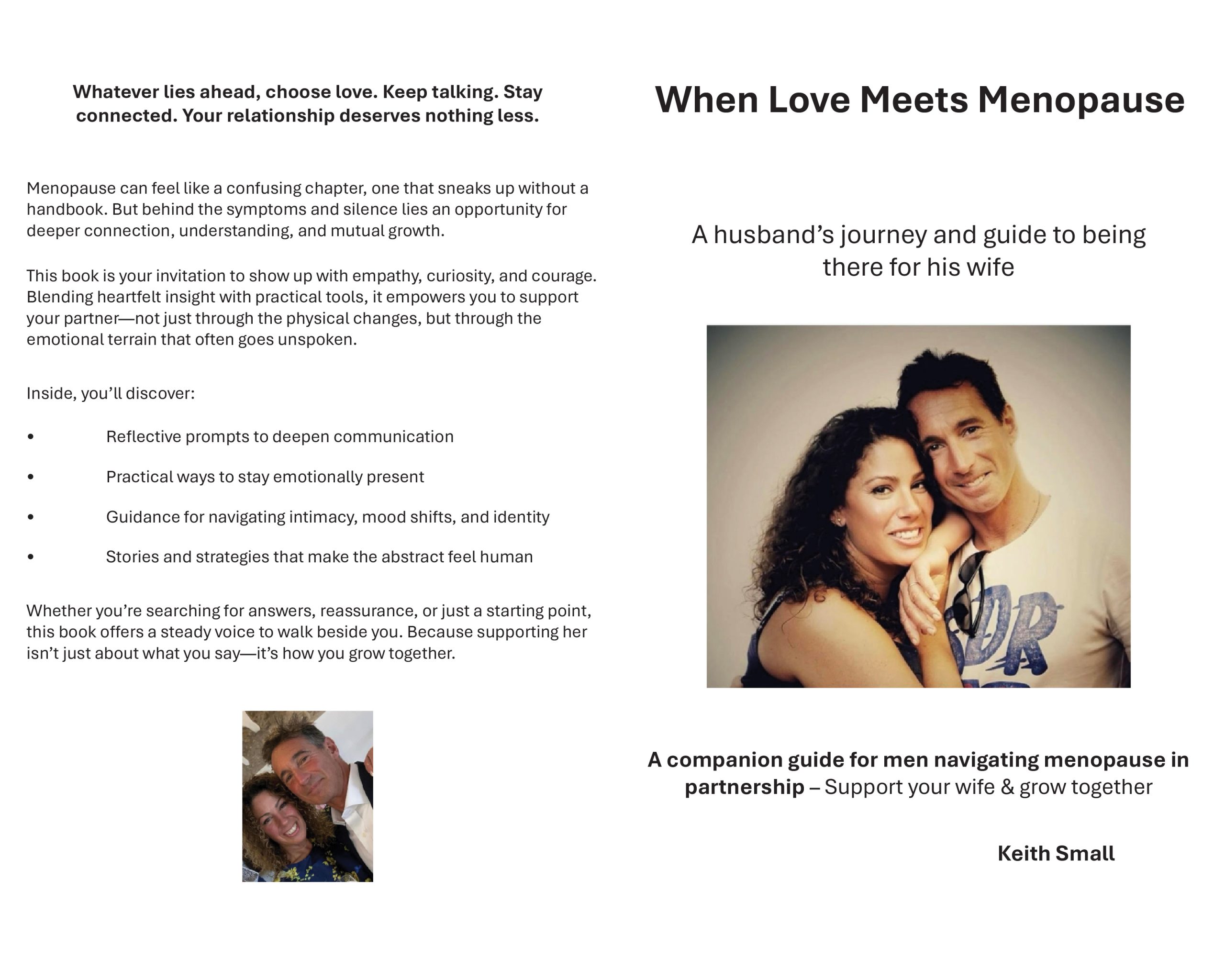
For over twenty years, my wife and I shared a bond built on laughter, honesty, and mutual respect. We were the couple that rarely argued. We found joy in the simple things, like a quiet coffee or a long walk. Our relationship was rooted in peace: and then, seemingly out of nowhere, the rhythm shifted.
Suddenly, I felt like I was walking on eggshells. I remember one specific afternoon when something as small as me simply breathing in her direction seemed to spark a wave of tension. I found myself asking the same question over and over: “What did I do?”
The problem was, I didn’t know the answer. And worse, as a man, my instinct was to fix it. I wanted to solve the problem, restore the calm, and get back to “normal.” But that fix-it instinct was actually deepening the divide.
I wrote my book, When Love Meets Menopause, because I realised that while I will never truly understand the experience from my wife’s perspective, I do understand the toll it takes on a marriage. If your world feels suddenly upside down, I want you to know: you’re not alone.
Moving from “Solver” to “Supporter”
As men, we are often wired to be problem-solvers. When our partner is in pain or frustrated, we look for the “why” and try to provide the “how-to-fix.” During menopause, this approach can backfire.
Menopause isn’t a broken appliance or a logistical hurdle. It is a profound physiological and emotional shift caused by fluctuating hormones that affect nearly every system in the body. When I tried to “fix” her mood or offer quick solutions, it felt to her like I was dismissing the depth of what she was feeling.
The most powerful skill I had to develop wasn’t speaking: it was listening. I had to learn to hold space for her emotions, even when they felt unfamiliar or, frankly, confusing to me. I started following a simple rule: Listen to understand, not to reply.
Building Your Own “Menopause Toolkit”
To be the partner she needs, you need a strategy. I like to think of this as a menopause toolkit for husbands. It isn’t about medical advice; it’s about relational tools that help you remain an anchor when the waves get rough.
Here are a few “tools” I’ve found essential:
- The Gift of Education: You don’t need to be a doctor, but you do need to understand the basics. Knowledge about hot flashes, brain fog, and sleep disturbances transforms you from a helpless bystander into an informed ally. When you know that her irritability is a biological response to dropping estrogen, it’s much easier not to take it personally.
- The “Listening Posture”: Before you react to a sharp comment, take a breath. Mirror back what you hear: “It sounds like you’re feeling completely overwhelmed right now.” Validating her feeling is often more restorative than any solution you could offer.
- Practical Advocacy: Take the lead on household tasks without being asked. If she’s struggling with sleep, handle the morning school run or the grocery shopping. Reducing her “mental load” is a tangible way to show love.
- Patience and Presence: Sometimes, the most loving thing you can do is just sit beside her in silence. Let her know you aren’t going anywhere, regardless of how stormy the day has been.
Why Personal Stability Matters for Professional Success
You might wonder why a coach who focuses on workplace motivation strategies is talking so deeply about marriage and menopause. The truth is, we don’t live our lives in silos. If your home life is in a state of high tension, your performance at work will inevitably suffer.
When you are distracted by conflict or worry at home, your “mental bandwidth” is depleted. This is where professional development coaching becomes so valuable. In my sessions with management teams and business leaders, we often find that the biggest barriers to productivity aren’t technical skills: they are the emotional stressors that follow us from the front door to the office desk.
By learning to navigate this transition with your partner, you are actually building high-level leadership skills: empathy, resilience, and adaptive communication. These are the same traits that drive a positive work culture and help you implement real-world behavioral changes in your team.
Navigating the Physical Shift
Let’s be honest: menopause affects intimacy. Shifts in estrogen can lead to physical discomfort and a decline in libido. It’s a sensitive topic that many couples avoid, but silence only breeds distance.
In my book, I talk about the importance of “re-learning” each other. The goal isn’t necessarily to get things back to exactly how they were ten years ago, but to find a new way of being close. This requires an incredible amount of honesty and vulnerability.
Talk about what feels good now and what doesn’t. Be willing to slow down. Focus on connection rather than “performance.” When she feels safe, seen, and supported in the kitchen and the living room, that sense of security eventually finds its way back into the bedroom.
Strengthening the Team
Menopause is often described as a “change of life,” but it doesn’t have to be the end of the life you’ve built together. It can be a turning point where your relationship becomes more resilient than ever.
I’ve seen this same principle work in organizations. When a team faces a major shift or a period of high stress, they can either fracture or they can use motivational mapping to understand each other’s drivers and pull together. Your marriage is the most important “team” you will ever lead.
If you’re feeling lost, remember:
- It’s not your fault, and it’s not her fault. It’s hormones.
- Education is your best defense. Read, listen, and learn.
- Your presence is your power. You don’t have to fix it; you just have to be there.
Let’s Walk This Path Together
If you are struggling to find your footing: whether it’s in your personal relationship or in how you lead your team through change: I am here to help. Sometimes, all it takes is a fresh perspective and a few actionable tips to turn “getting by” into “getting on with it.”
I offer coaching and motivational mapping services designed to help you reach your full potential, both at home and in the workplace. We can look at the “thinking-feeling-doing” cycle together and set measurable goals to help you regain your sense of calm and purpose.
I’d love to hear your story and see how I can support you. If you’re ready to take a step forward, why not book a 30-minute taster session with me? It’s a low-pressure way for us to chat about what’s going on and see if I’m the right partner for your journey.
You’ve got this. And I’m here to help you get on with it.